October 6, 2026
Predictive Scheduling Rules in Restaurants
Learn how 2026 predictive scheduling laws affect callouts, clopening, and premium pay, plus practical steps to reduce compliance risk.
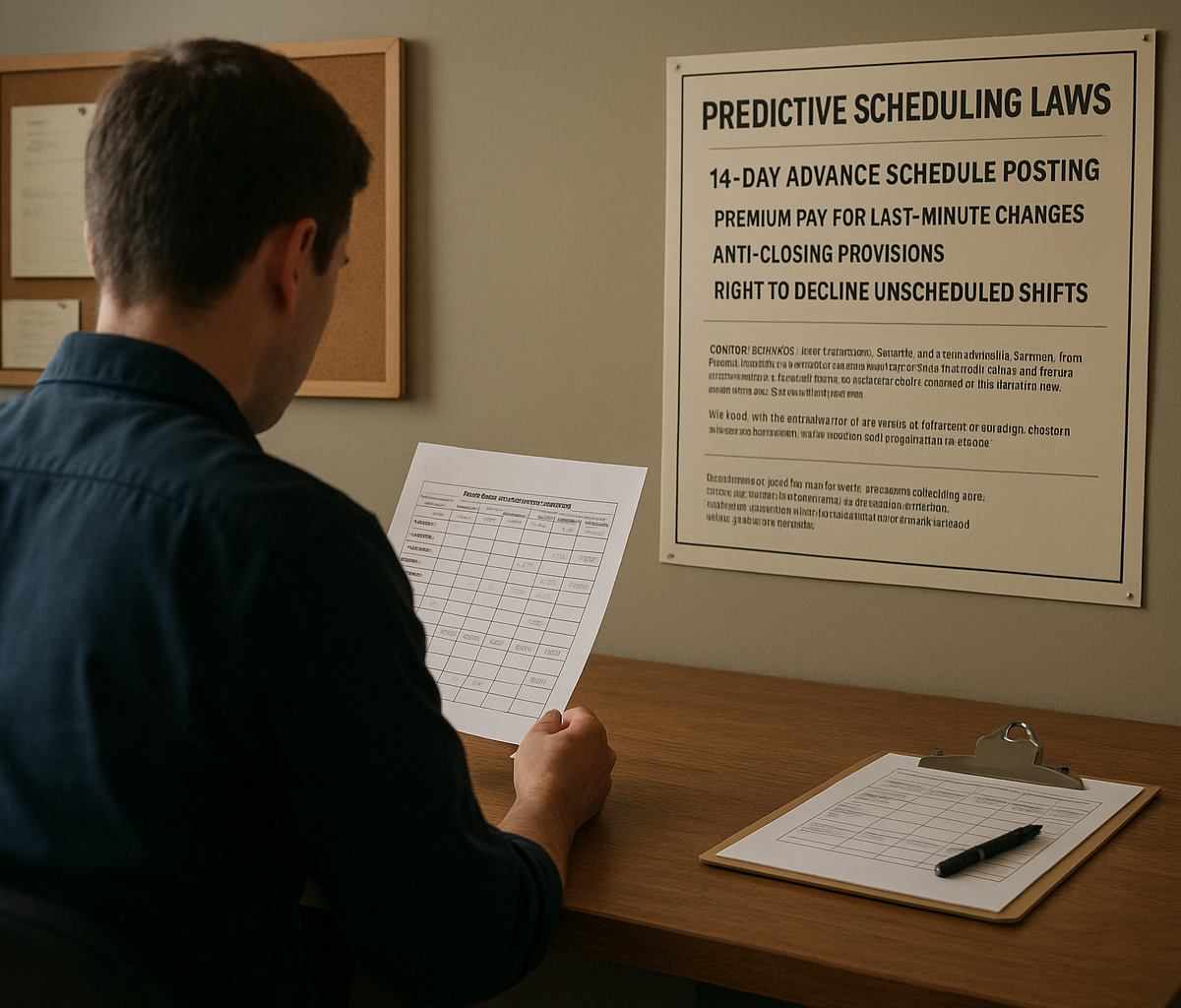
The problem usually starts at 6:12 p.m. A line cook calls out. The dinner push is already building. The manager has a posted schedule on the wall, a short bench, and about three minutes to decide whether filling that gap will trigger premium pay, violate a rest rule, or create a retaliation claim later.
That is what predictive scheduling looks like in practice. It is not a legal memo. It is a busy shift, a missing employee, and a manager trying to keep service moving without stepping over rules that are getting stricter in more cities every year.
Why predictive scheduling laws matter in 2026
By 2026, fair workweek and predictive scheduling laws are no longer an isolated issue for a few major markets. Restaurants operating in Oregon, New York City, Chicago, Seattle, San Francisco, Philadelphia, Los Angeles, and other jurisdictions are dealing with requirements that can include posting schedules 14 days in advance, paying premiums for employer-initiated last-minute changes, limiting clopening shifts, and allowing employees to decline unscheduled hours without punishment.
For restaurant managers, the operational risk is easy to underestimate. Most violations do not come from a dramatic labor dispute. They come from ordinary scheduling habits that made sense ten years ago. Texting a server the night before to start earlier. Asking a dishwasher to stay late after a rush. Sliding an opener into a close because two people called out. In many locations, those moves now carry legal and payroll consequences.
Callout coverage and shift changes are where trouble starts
The biggest point of confusion is the difference between an employer-directed schedule change and a worker-initiated shift pickup. That distinction matters. If a manager changes a posted schedule, premium pay may apply. If an employee voluntarily accepts an open shift, the result can be treated differently under local rules, depending on the jurisdiction and the facts documented at the time.
This is where many restaurants get exposed. A manager sends a group text, one person agrees, and everyone moves on. Weeks later, there is no clean record showing when the request went out, who received it, whether the shift was optional, or whether the employee accepted freely. Without that paper trail, a routine callout can look like an imposed modification.
Some operators are addressing that gap with structured communication tools. Truvex, for example, logs coverage requests, records that the shift was offered out, and captures worker opt-in. That does not replace legal review or local policy, but it does create documentation that can help show the change was voluntary rather than forced.
No-show prevention starts with better scheduling systems
Predictive scheduling compliance is not only about what happens after a callout. It starts earlier, with cleaner forecasting and more disciplined posting. Managers who consistently publish realistic schedules on time tend to face fewer emergency edits. That sounds obvious, but it often breaks down when labor targets are set too aggressively or sales forecasts are built on hope instead of patterns.
A practical approach is to separate true emergencies from preventable instability. A sudden illness is one thing. Chronic understaffing caused by cutting too close on labor is another. Laws are generally less forgiving when last-minute changes become standard operating procedure.
Clopening, labor cost, and manager habits
Anti-clopening rules deserve special attention because they are easy to violate during a scramble. A manager trying to cover a Friday night hole may ask the same reliable employee to open Saturday morning. If the required rest window is not met, that decision can create immediate compliance problems, even if the employee says yes in the moment.
There is also a labor cost angle. Predictive scheduling laws can turn reactive staffing into expensive staffing. Premium pay, overtime spillover, and avoidable turnover all stack up. The cheapest fix is usually not the one made at the last second. It is the one built into scheduling discipline, cross-training, and a clear process for offering extra hours fairly.
What restaurant managers should tighten up now
Most compliance improvements are not complicated, but they do require consistency. Posted schedules should be timestamped and preserved. Open shift offers should be documented. Managers should know which changes trigger reporting pay or predictability pay in each jurisdiction. Employees should be able to decline unscheduled shifts without pressure, especially in writing where a record exists.
It also helps to train managers on language. “Can anyone voluntarily pick up this shift?” is not the same as “Need somebody to take this now.” One sounds like an offer. The other can sound like an expectation. In a dispute, wording matters.
Predictive scheduling laws are forcing restaurants to treat scheduling as a compliance function, not just an operations task. That shift is overdue. In this business, every schedule change feels urgent. The challenge in 2026 is making sure urgency does not become liability.