September 1, 2026
Why Shift Coverage Systems Keep Breaking
See why phone trees, group texts, and chat apps fail under pressure, and what restaurant managers need from a real callout process.
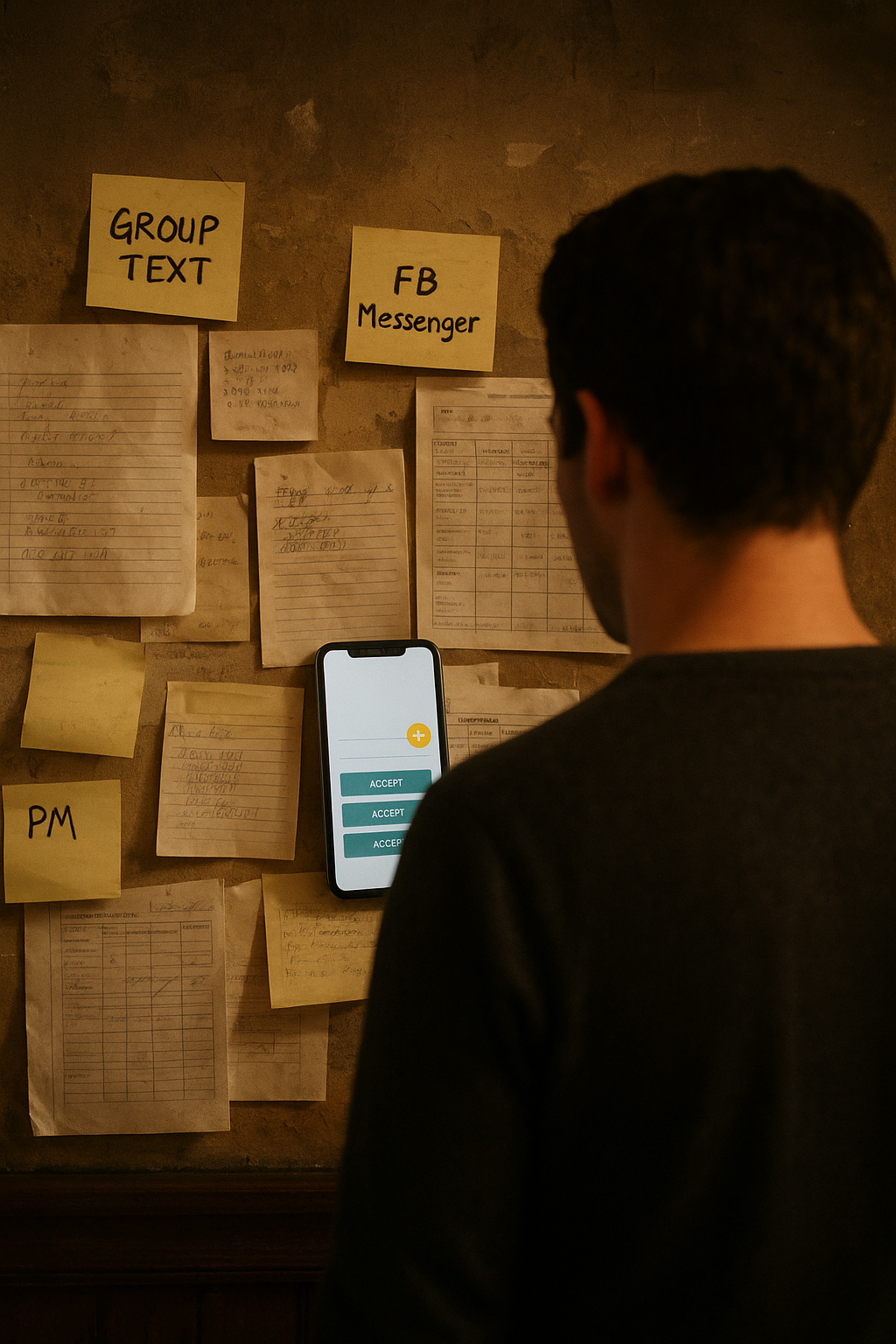
It usually starts at the worst possible time. A line cook calls out 90 minutes before dinner. The manager grabs the old contact list, starts dialing, gets two voicemails, one maybe, and three people who never answer unknown numbers. By the time someone agrees to cover, prep is behind, the floor is tense, and labor decisions are already being made under pressure. Most restaurants do not arrive at a better system because they enjoy changing process. They get there because the old one finally collapses on a busy night.
That pattern is familiar across hospitality. Shift coverage methods often evolve in stages. Each one solves the last problem for a while, then creates a new one. The issue is rarely effort. Operators usually try plenty of things. The issue is that most coverage systems were never designed for the speed and uncertainty of a same-day callout.
The handwritten phone list and early callout routine
For a long time, the standard approach was simple. Keep everyone's number in a binder, taped inside an office cabinet, or saved in a manager's phone. When a no-show or sick call hit, someone started calling down the list. It felt organized because there was a process. In practice, it depended on one person having the time to chase responses while also running a shift.
This method breaks in obvious ways. Numbers go out of date. Availability changes. Workers do not pick up during class, on transit, or while sleeping after a late close. The bigger problem is that the process is one-directional. A manager has to ask one person at a time, then wait. In a restaurant, waiting is expensive.
Why group texts fail for shift coverage
Group texts looked like progress. One message, many recipients, faster replies. For smaller teams, it often worked. Then the staff grew, turnover picked up, and the chat became its own problem. Replies stacked up out of order. Somebody answered only to realize the shift was already taken. Another worker muted the thread weeks ago because it never stopped buzzing. Managers still had to sort through the noise and figure out who was actually qualified, available, and approved for that role.
There is also the issue nobody likes to say out loud. Group texts can create social pressure. Some staff feel watched. Others jump in just to be helpful, then back out when they realize they cannot make it. What looked faster on paper often turned into more follow-up, not less.
Messenger, WhatsApp, and scheduling workarounds
Many operations then move to chat apps like Facebook Messenger or WhatsApp, or try to force the problem into a scheduling platform. Again, these tools help for a while. Read receipts offer some visibility. Threads are easier to search. Coverage requests feel more centralized.
But general communication tools are still general communication tools. They are built for conversation, not for urgent staffing decisions. Messages get buried between memes, shift swaps, and manager updates. Scheduling software has a similar weakness when coverage is treated as a side feature. If the process takes too many taps, depends on staff opening one specific app, or does not reach people by text as well, response rates drop fast.
What a no-show system needs under pressure
When a callout hits, managers do not need another place to chat. They need a short path from problem to answer. The strongest systems tend to share a few traits:
- They notify all qualified off-duty workers at once.
- They use more than one channel, because push alone is easy to miss.
- They let multiple employees accept, so the manager has options.
- They keep the final decision with the manager, not the fastest phone.
That is why some operators eventually move to a purpose-built tool. Truvex fits that category. Instead of treating shift coverage like a minor feature inside a larger scheduling stack, it focuses on the actual callout moment. One action notifies qualified off-duty staff by push notification and SMS, interested workers can accept, and the manager decides who gets the shift. It is a narrow use case, but that is the point.
Scheduling, labor cost, and the hidden cost of bad coverage
Coverage problems are rarely just coverage problems. They hit labor cost, service speed, and retention. When the same reliable people are always called first, burnout follows. When managers spend an hour hunting for a replacement, other standards slip. Breaks get skipped. Tickets drag. Guests feel it, even if they never know why.
A better process does not eliminate callouts. Nothing will. Restaurants are staffed by human beings, and human beings get sick, have childcare issues, and run into life. The real goal is more modest and more useful, reduce the scramble, cut the dead time, and make the response repeatable.
Most restaurants really do try everything before they adopt a tool built for the problem in front of them. That trial-and-error path is common because each workaround seems good enough, until a slammed Friday proves otherwise. In this business, systems are judged in the middle of the rush. If a coverage process cannot hold up there, it is not a process. It is just hope with extra steps.