August 30, 2026
Predictive Scheduling Rules in 2026
Learn how predictive scheduling laws affect callouts, clopening, and labor costs, plus practical steps to reduce premium pay and compliance risk.
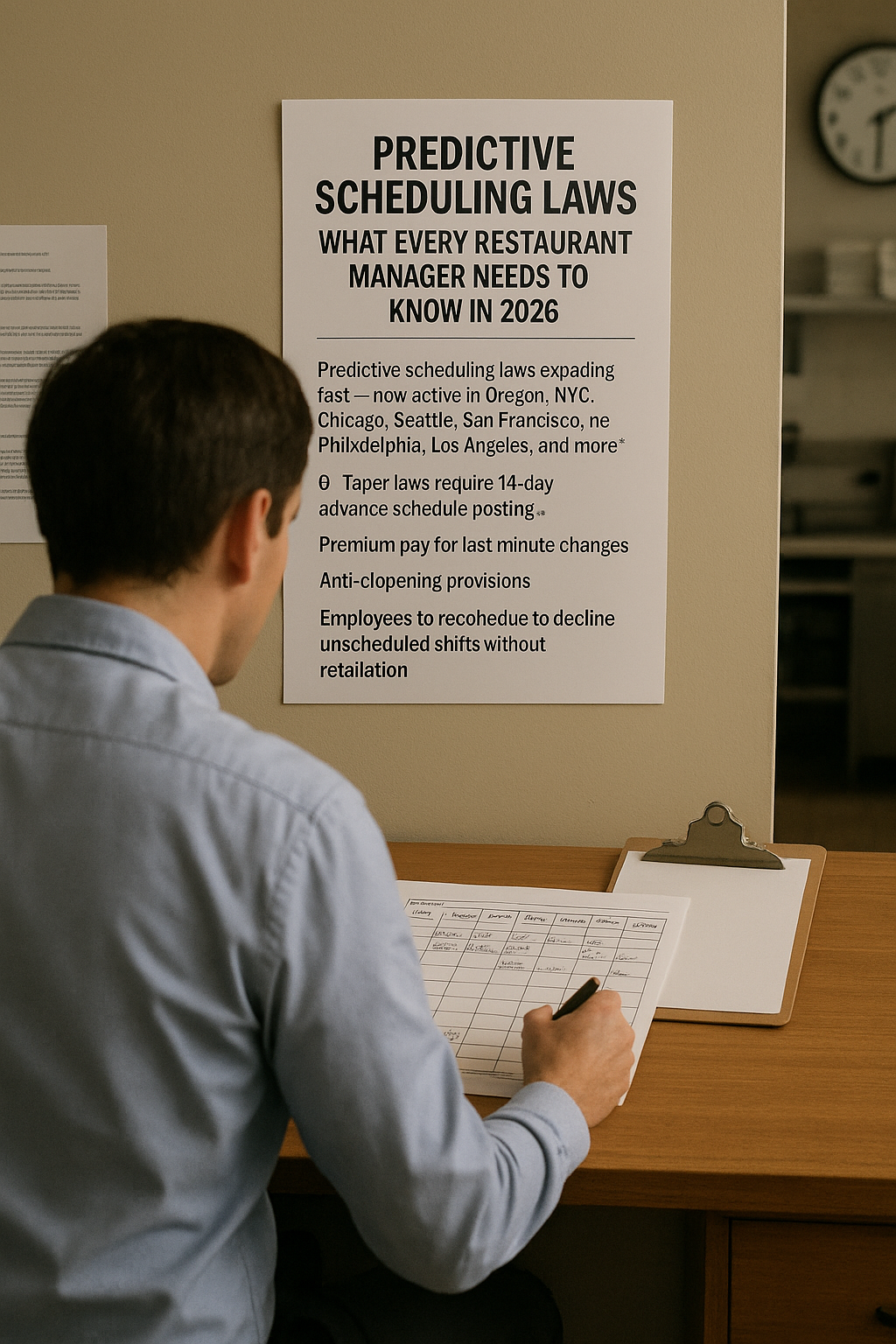
The problem usually starts at 3:17 p.m. A line cook calls out, dinner reservations are stacked, and the posted schedule is already live. In a lot of cities, that is no longer just an operations headache. It is a compliance decision with payroll consequences.
Predictive scheduling laws, sometimes called fair workweek laws, have moved well beyond a niche labor issue. By 2026, restaurant managers in places like Oregon, New York City, Chicago, Seattle, San Francisco, Philadelphia, and Los Angeles are dealing with some version of the same core rule set: schedules posted in advance, limits on clopening, extra pay for certain last-minute changes, and protections for workers who decline unscheduled hours.
The details vary by jurisdiction, which is exactly what makes this tricky. A policy that works in one market can create liability in another. Still, the operational pressure points are consistent across the board.
What predictive scheduling laws usually require
Most laws focus on four areas. First, employers must post schedules a set number of days in advance, often 14 days. Second, if management changes that schedule inside the notice window, the employee may be owed premium pay. Third, many laws restrict clopening shifts, where a worker closes late and returns early the next morning without adequate rest. Fourth, employees generally have the right to refuse added hours or altered shifts that were not part of the posted schedule.
That last point matters more than many managers realize. In practice, it means a manager cannot treat every callout the same way it was handled five years ago. Blasting out a text that pressures someone to come in can create risk if the shift was not truly voluntary.
Callout coverage and premium pay risk
A same-day callout is where compliance and operations collide. The business still needs coverage. Guests still show up. But if a manager reassigns a scheduled worker, extends someone without proper notice, or leans on an employee who feels unable to say no, the cost may go beyond overtime. It can trigger predictability pay, recordkeeping issues, or employee complaints.
The safer approach is to separate voluntary shift coverage from manager-imposed schedule changes. That means documenting who was offered the shift, when the offer went out, whether acceptance was optional, and who opted in. If the worker initiated the acceptance and had the legal right to decline, the record should show that clearly.
This is one reason some operators use tools like Truvex during callouts. The practical value is not just speed. It is the paper trail, or more accurately the digital trail, showing that the coverage request went to qualified off-duty staff, that workers chose to accept, and that the manager selected from voluntary responses rather than assigning the shift by force.
Scheduling practices that hold up under scrutiny
Managers do not need a law degree to reduce exposure, but they do need discipline. Predictive scheduling compliance usually comes down to routine. Post schedules on time. Keep records of every revision. Train supervisors not to make off-the-books schedule changes in a group chat. If a city requires employee consent for certain changes, get that consent in a format that can be retrieved later.
It also helps to build schedules with a little more realism. Chronic understaffing creates a constant stream of last-minute edits, and that is exactly what these laws are designed to discourage. A schedule that is technically posted 14 days ahead but rewritten every other day is not much of a defense.
No-show prevention starts before the shift
Predictive scheduling laws do not cause callouts, but they expose weak scheduling habits fast. Restaurants that scramble most often tend to have the same patterns: unclear availability, poor cross-training, no backup list, and supervisors making exceptions on the fly.
Better systems usually include a few basics:
- current availability on file for every employee
- a qualified backup pool by role and station
- written procedures for callouts and shift swaps
- consistent records of who accepted extra hours voluntarily
Even simple structure can make a difference. If a server calls out at noon, the manager should already know which trained employees are off, who is approaching overtime, who can legally work the turnaround, and what communication method preserves a clean record.
Labor cost, turnover, and the bigger picture
Some operators still view predictive scheduling as just another labor mandate. That misses the larger point. Unstable schedules drive turnover, and turnover creates the very staffing instability that leads to more last-minute changes. It becomes expensive in every direction, payroll, recruiting, training, and morale.
Compliance does not remove the chaos from restaurant work. A Friday night callout will always be a Friday night callout. What changes in 2026 is that the response needs to be structured, documented, and genuinely voluntary when the law says it must be. The managers who adapt fastest will not be the ones with perfect staffing. They will be the ones whose systems still hold together when the shift goes sideways.